

Key Takeaways
- The AI skills that pay off for SEO cover a job your team repeats with the same inputs: audits, clustering, briefs, link passes, and fact checks.
- They work best chained in pipeline order, from keyword research through to the published page, with a person signing off before anything goes live.
- The community and Anthropic skills on the Exchange install as folders. TripleDart's entries publish the design of a production pipeline you rebuild yourself.
- Google's guidance welcomes AI for research and structure, but warns that many pages made without added value may break its scaled content abuse policy.
The best AI skills for SEO are written procedures Claude follows for one repeatable job. The core set covers the site audit, keyword clustering, the content brief, and the fact check.
What Makes a Good AI Skill for SEO
A good AI skill for SEO turns a job you already do by hand into the same output every time.
A Claude skill is a folder holding a SKILL.md file, with written instructions and any scripts the job needs. Claude loads it when a task matches, so the steps are set before the work starts.
The community libraries in the directory follow the Agent Skills spec and install with one command, which also covers Codex and Cursor. Anthropic's own skills install as a Claude Code plugin and reach Claude.ai on paid plans.
The Exchange's Claude skills directory has the install steps for each library.
The directory lists 87 skills across eight functions. Its bar for getting on the list is a useful test for any SEO skill: the procedure has to be specific enough that two people running it get the same shape of output.
For SEO work, I'd add two more questions:
- Can it reach your data? An audit or a clustering run is only as good as its inputs, so check whether it reads Search Console, Ahrefs, Semrush, or a crawl, or only what you paste in.
- Does it leave the judgment calls to you? The good ones make the mechanical part repeatable and hand back the decisions, such as the angle of a brief or which pages to merge.
Keyword clustering is the clearest example. Grouping keywords and labeling intent follow rules a skill can apply, while choosing which cluster becomes a page depends on your business.
TripleDart's keyword research write-up shows that split in production: Claude takes the mechanical 80% of clustering and intent, and an analyst keeps three judgment calls.
The Best AI Skills for SEO and Content Marketing, by Stage
These are the SEO and content skills from the directory that a team can chain into one pipeline. Each name links to its full entry in the directory.
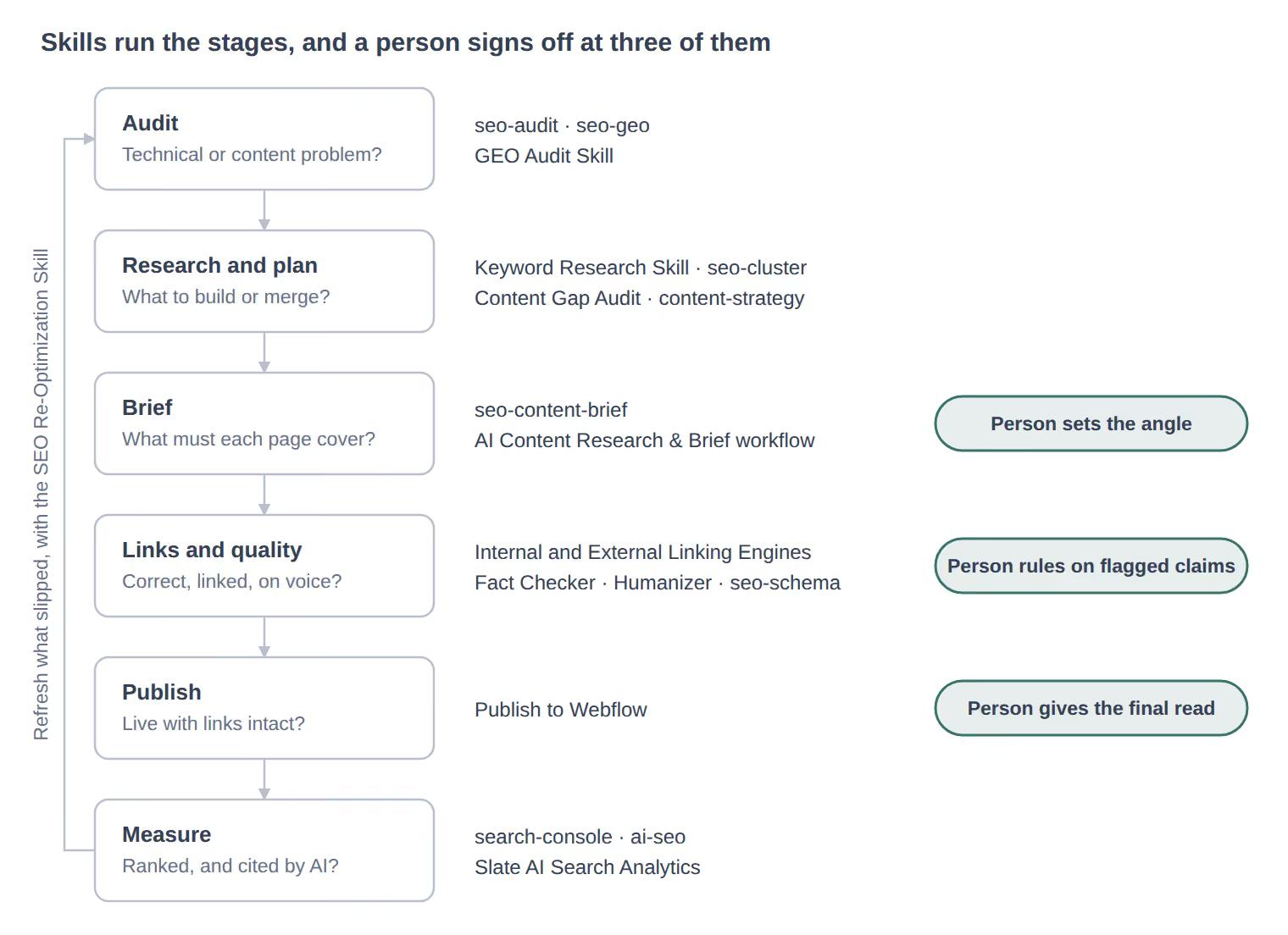
Each stage hands its output to the next. The loop on the left sends pages that slipped back through the audit.
| Stage | Skill | What it does | Made by | Installs |
|---|---|---|---|---|
| Audit | seo-audit | Crawls the site, runs a specialist agent per area, and returns a plan tied to a health score | Agrici Daniel | Yes |
| Audit | GEO Audit Skill | Runs five subagents at once on AI search, then sorts the action plan | TripleDart | Design published |
| Audit | seo-geo | Scores passages for citability and checks whether AI crawlers can reach the page | Agrici Daniel | Yes |
| Research | Keyword Research Skill | Pulls your positions 4 to 15 in the same run, where the quick wins sit | TripleDart | Design published |
| Research | seo-cluster | Groups keywords when Google ranks the same pages for both | Agrici Daniel | Yes |
| Plan | Content Gap Audit | Turns the gaps against competitors into a sorted roadmap | TripleDart | Design published |
| Plan | content-strategy | Splits search pillars from shareable pieces and maps keywords to four buyer stages | Corey Haines | Yes |
| Brief | seo-content-brief | Sets the length of each section and the competitor gap it fills | Agrici Daniel | Yes |
| Brief | AI Content Research & Brief Creation Workflow | One keyword at a time, with every fact confirmed against its source | TripleDart | Yes, as a zip |
| Links | Internal Linking Engine | Places internal links by written thresholds | TripleDart | Design published |
| Links | External Linking Engine | Adds outbound citations by source tier, with no invented links | TripleDart | Design published |
| Quality | Fact Checker | Checks claims in three phases, with a different model for each | TripleDart | Design published |
| Quality | Humanizer | Enforces brand voice, then strips recognizable AI writing patterns | TripleDart | Design published |
| Quality | seo-schema | Checks structured data against the schema types Google still supports | Agrici Daniel | Yes |
| Refresh | SEO Re-Optimization Skill | Audits a page for a refresh, with listicles treated as their own case | TripleDart | Design published |
| Publish | Publish to Webflow | Sends a finished draft to the CMS with headings and links intact | TripleDart | Design published |
| Measure | search-console | Answers Search Console questions in a sentence, including index coverage | Open Claudia | Yes |
| Measure | ai-seo | Takes a baseline across ChatGPT, Perplexity, and AI Overviews before any change | Corey Haines | Yes |
| Measure | Slate AI Search Analytics | Share of voice, citations, and sentiment in AI answers, asked in plain English | Slate | Needs a paid Slate workspace |
TripleDart runs the Exchange and builds Slate. Their entries are listed because the designs are published, and each card says TripleDart or Slate sells the service or platform behind it.
How to Test an SEO Skill Before Your Team Relies On It
Test each skill on a job you've already done by hand, where you know the right answer. For SEO skills, run these four checks:
- Audit a page whose problem you already found. The audit skill should find the same issue and rank it near the top.
- Cluster a keyword set you grouped last quarter. Count the keywords it places differently, then read why.
- Brief a page that already ranks. The brief should ask for what the ranking page covers, plus at least one gap.
- Plant a wrong claim in a draft. The fact check should catch it and name the source that contradicts it.
Two things trip teams up when they chain skills. First, the "Design published" entries are production pipelines TripleDart runs on the Claude API. There's no folder to copy, only published thresholds to rebuild from.
Second, two skills with different rules for the same output conflict. One might set the brief's total length while another sets word counts per section, and the draft can follow only one.
The directory's FAQ notes the later one usually wins, so keep each skill's scope to one stage of the pipeline.
Where SEO Automation With Skills Breaks
SEO automation breaks where the output scales faster than the checking. These show up most in SEO and content work:
| Failure | What you see | What prevents it |
|---|---|---|
| Pages at scale with nothing added | Hundreds of template pages that differ only by a keyword | The programmatic-seo skill's defensibility ladder, which tells you whether your data can carry a template |
| Unchecked facts | A published statistic its source doesn't support | A fact-check skill on every draft, then a person on anything it flags |
| A skill gone stale | Advice built on schema types or tool behavior that has since changed | One owner per skill, and a review whenever the tool underneath it changes |
| Broken credentials | A scheduled run that returns partial data and no error | A check that each connection works before the run starts |
Thin pages at scale are a search risk as well as a quality one. Google's guidance on generative AI content says AI can help with research and structure, and that generating many pages without adding value for users may violate its scaled content abuse policy.
The same guidance calls it critical to factcheck and review AI-generated content before publishing. Let a skill do the first pass of that check, and keep a person on the second.