


Preview
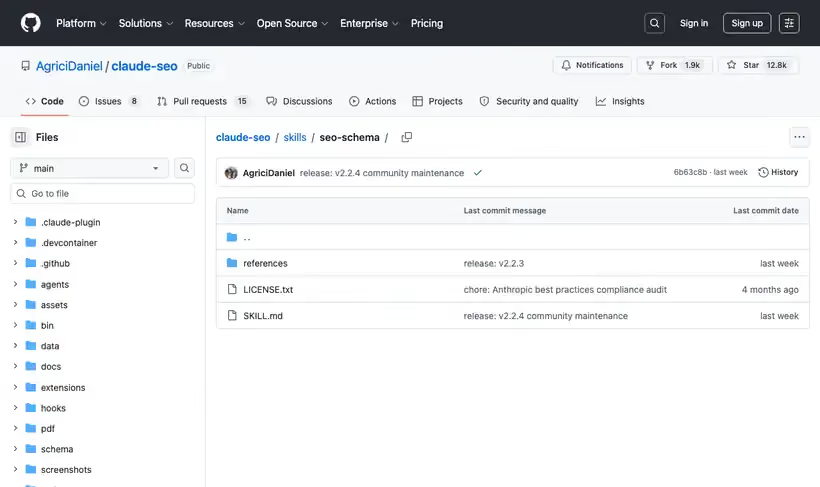
What it is.
It reads what is on the page first: JSON-LD, then Microdata, then RDFa. Then it validates against Google's supported rich result types and checks the errors that break markup silently, including a missing context, the wrong data type, leftover placeholder text and relative URLs where absolute ones are required.
The deprecation list is the part that earns its place. Schema types get retired and pages keep carrying them, so a validator that only checks syntax reports a clean page that Google ignores.
What you get.
- Detection across JSON-LD, Microdata and RDFa
- Validation against Google's supported rich result types
- A generated JSON-LD block where markup is missing
- A deprecated-type check, kept in a reference file
- A common-error list covering placeholder text and relative URLs
How to set it up.
Install the Claude SEO plugin, then run /seo setup once.
Call it with a page URL. It takes the URL as its only argument.
Read the detection output before the recommendations. A page carrying Microdata and JSON-LD for the same entity is a conflict worth resolving first.
Convert to JSON-LD where you have a choice. The skill treats it as the primary format because it is Google's stated preference.
Check the deprecated list against your templates. Any type flagged there is markup you can delete.
Change relative URLs to absolute inside the markup, which is one of the errors the validator names explicitly.
Pricing Plans
Free. MIT license.
Included inside the Claude SEO plugin. Checked against the repo in July 2026.
Use cases
Validating a new template
A template rollout will multiply any markup error across every page it produces. Run one URL through before launch; the validation catches what would have replicated sitewide.
Rich results that vanished
Stars or FAQs stopped appearing and the syntax validator calls the page clean. Give it the URL; the deprecated-type check names markup Google has retired, which syntax checks never flag.
Resolving duplicate markup
One page carries Microdata and JSON-LD for the same entity. The detection output surfaces the conflict, and the guidance consolidates on JSON-LD as Google's stated preference.
Generating missing markup
A page type has no structured data at all. Point it at the URL; where markup is missing, a generated JSON-LD block comes back ready to place.
Best for
A template rollout
Schema errors replicate across every page a template produces, so validating one URL catches a site-wide problem.
Rich results that stopped appearing
A deprecated type is a common cause, and syntax validators report those pages as clean.
AEO groundwork
Structured data is one of the signals answer engines read, and seo-geo checks the rest.