


Preview
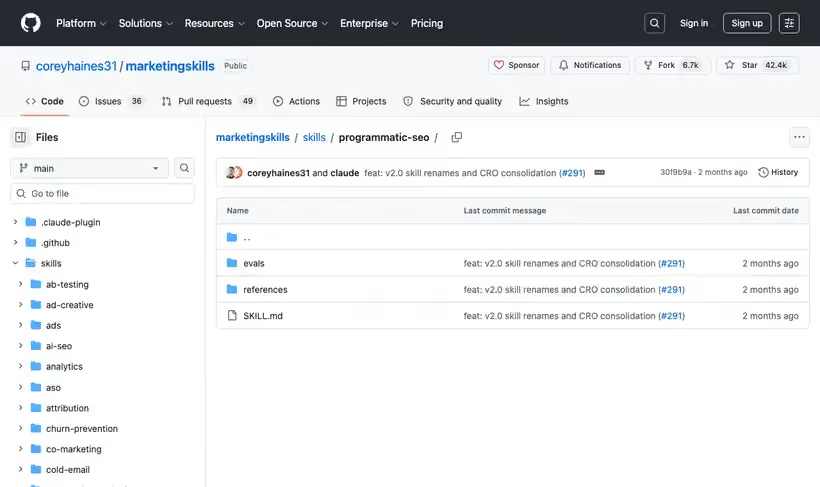
What it is.
It grades your data first, from proprietary at the top down to public at the bottom, then matches what you own to one of 12 named page patterns with an example query for each.
You come out with a pattern, a URL structure and a quality gate before anyone builds a template. The constraints are hard: subfolders over subdomains, and 100 good pages ahead of 10,000 thin ones.
What you get.
- A data defensibility ladder, from proprietary down to public
- 12 page patterns with an example query and an implementation reference for each
- A table matching what you own to the pattern it can support
- URL structure rules, with subfolders preferred over subdomains for authority
- A doorway-page and thin-content checklist to run before you generate anything
How to set it up.
Install with npx skills add coreyhaines31/marketingskills --skill programmatic-seo, and pass -a claude-code so it lands in .claude/skills.
Run the product-marketing skill first if you have not. Every skill in this library reads .agents/product-marketing.md before it asks you anything.
Answer the opportunity questions: what search patterns exist, how many pages they could support, and how volume is spread across them.
Place your data on the defensibility ladder honestly. Public data puts you at the weakest rung, which changes the pattern you should pick.
Choose one pattern from the matching table, then layer a second only when the combination has genuine volume behind it.
Set the URL structure as subfolders before you build, because moving from a subdomain later splits authority you already earned.
Pricing Plans
Free. MIT license.
Checked against the repo in July 2026.
Use cases
The viability verdict
A pSEO build is about to get commissioned. Place your data on the defensibility ladder first; if public data is all you own, the answer comes back before anyone builds a template.
Matching data to a pattern
The data on hand is an integrations directory and its fit is unclear. The matching table reads what you have and points at the pattern it can carry, with an example query attached.
Reviewing generated pages
A template already produced its pages. Run the doorway and thin-content checklist on a sample before the full set publishes; failures surface while they're still cheap to correct.
Settling URLs before launch
Engineering wants the pages on a subdomain. Bring the plan through the URL structure rules; subfolders win, and settling that now beats splitting authority you've already earned.
Best for
Deciding whether pSEO is viable at all
The defensibility ladder answers this in one pass. If your only input is public data, the skill says so before you commission a build.
Choosing between comparison and integration pages
The matching table keys off what you own, so a product with an integrations directory gets pointed at integration pages instead of location pages.
Reviewing a template someone already built
The thin-content and doorway-page checks give you a concrete list to score existing pages against.