

Key Takeaways
- Pick AI skills by the job they do, and start with one job your team repeats every week.
- The content brief and fact-checking skills pay off fastest, because they sit on either side of every article.
- Open-source skills from Anthropic, Coupler.io, and others cover copy, campaign plans, and reporting, and many work beyond Claude.
- A skill that writes outreach or ad changes still needs a person to approve the result.
- Test each skill against your own past work before you trust it with new work.
- Once two or three skills run well, use skill creator to write one for your own process.
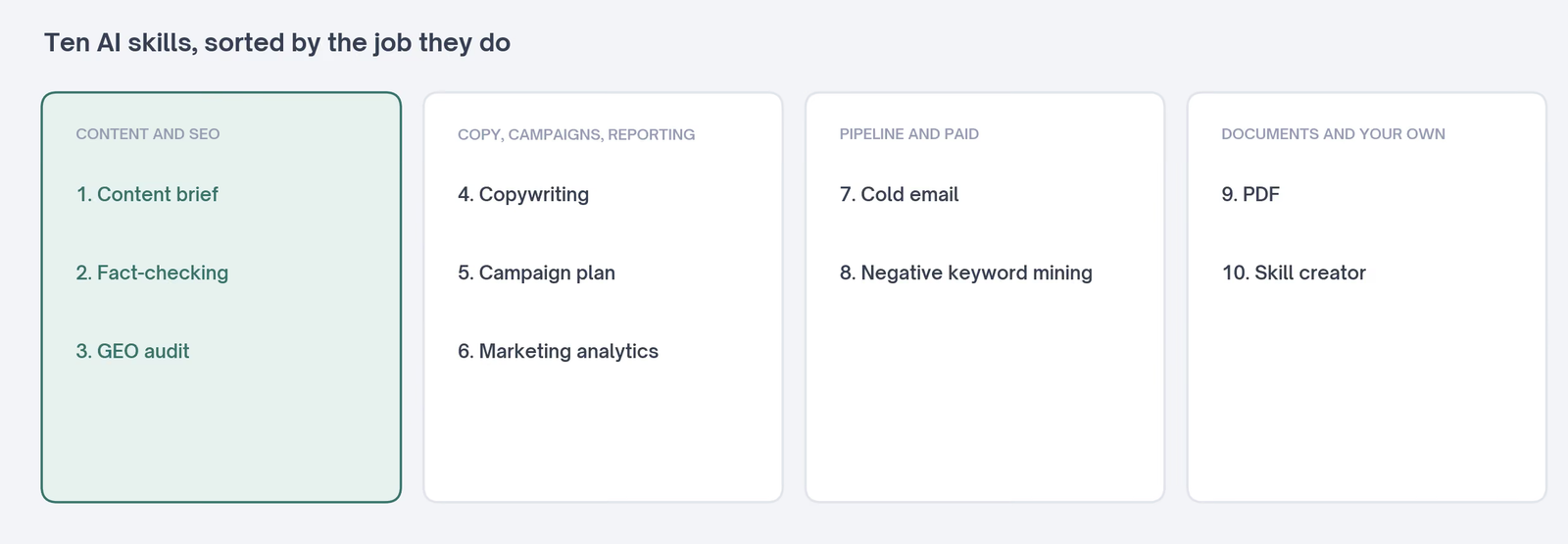
The AI skills worth trying first are the ones that do one marketing job the same way every time. For B2B teams, that means briefs, fact-checking, AI search audits, copy, campaign plans, marketing reports, cold email, paid search cleanup, PDFs, and a skill for writing your own. All ten are free to try.
Public libraries now list thousands of AI skills, and even Anthropic publishes its own repository of example skills, from PDF handling to brand guidelines.
With that many to choose from, the hard part is picking what to try first. It's easy to start with the most impressive skill on a list, run it once, and never find a job for it.
This list starts from the job instead. Each pick does one piece of B2B marketing work that comes up every week, and each comes with a test you can run in an afternoon against work you've already done.
If you're new to the idea, the Exchange's guide to what AI skills are covers how a skill works, and the Claude skills setup guide covers installing one. This piece is about which ones to try.
How These AI Skills for Marketing Were Picked
Every skill on the list had to clear four bars:
| Bar | Why it matters |
|---|---|
| Free to open and try | You can test it before anyone approves a budget |
| One clear job | A skill that does everything is hard to judge |
| Useful to a B2B team every week | A skill you run once a quarter never gets good |
| A result you can check | You need a way to tell a good run from a bad one |
I also left out any skill whose page didn't say what it can't do, since a skill that hides its limits is hard to trust with client work, however good its demo looks.
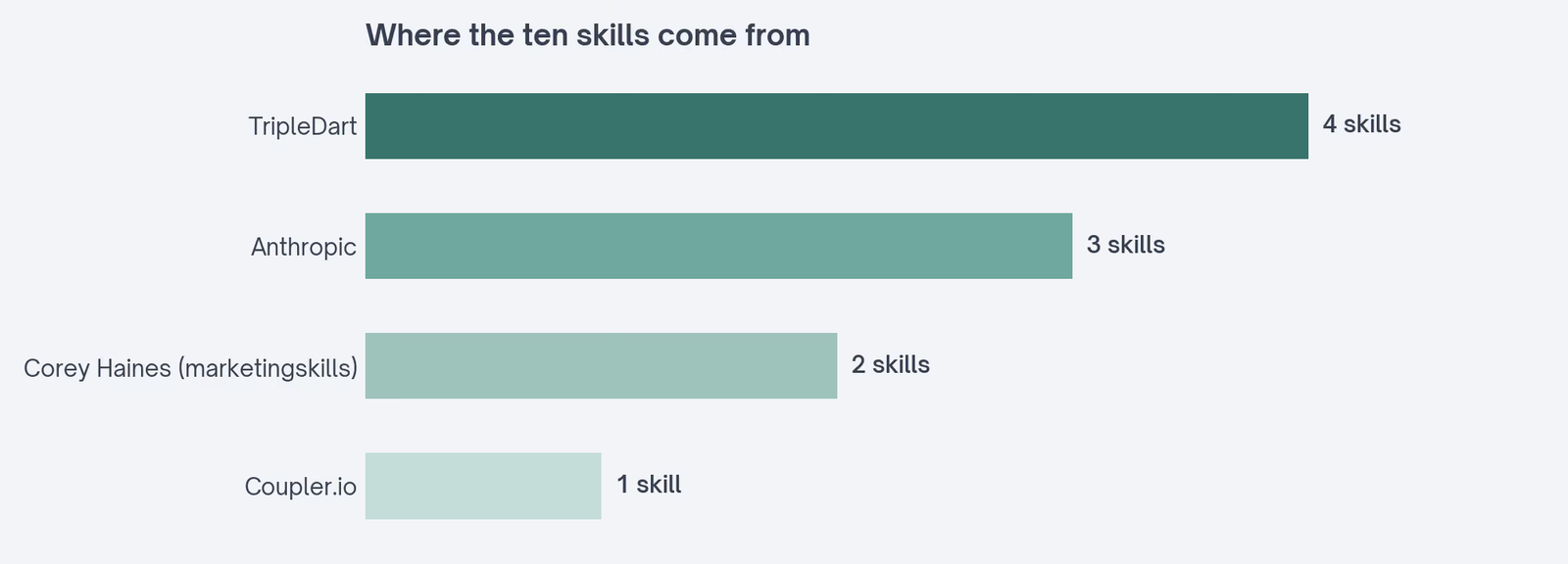
The picks come from four places:
- Anthropic, whose public skills repository holds the PDF and skill creator skills, and whose open-source marketing plugin holds the campaign plan skill.
- TripleDart, which publishes four of the skills it runs for clients on the Exchange, free to download.
- Corey Haines, who runs the B2B SaaS marketing agency Conversion Factory and writes the Swipe Files newsletter. His marketingskills collection is the source of the copywriting and cold email skills.
- Coupler.io, whose open-source skills repository holds the marketing analytics skill.
Between them, the four sources cover every job on the list, and the Anthropic and marketingskills picks work in any tool that supports the Agent Skills format.
Four of the ten are TripleDart's, and the Exchange runs on TripleDart's work, so I've held those to the same bar and named their limits the same way.
What Didn't Make the List
A few kinds of skill came close and didn't make it. One is skills built around a single company's stack. They can be excellent, but a skill that expects a specific CRM setup is hard for anyone else to test in an afternoon.
The 10 AI Skills at a Glance
| # | Skill | The job | From |
|---|---|---|---|
| 1 | Content brief | Turn a keyword into a writer-ready brief | TripleDart |
| 2 | Fact-checking | Check every claim in a draft against a source | TripleDart |
| 3 | GEO audit | Score how ready a site is for AI search | TripleDart |
| 4 | Copywriting | Write or rewrite copy for any marketing page | marketingskills |
| 5 | Campaign plan | Turn a goal into a campaign brief | Anthropic |
| 6 | Marketing analytics | Analyze campaign performance across channels | Coupler.io |
| 7 | Cold email | Write and test cold outreach | marketingskills |
| 8 | Negative keyword mining | Cut wasted spend from paid search | TripleDart |
| 9 | Read, fill, and build PDFs | Anthropic | |
| 10 | Skill creator | Write and test a skill of your own | Anthropic |
AI Skills for Content and SEO
1. Content Brief Skill
The content brief skill takes a keyword and returns a brief a writer can start from. TripleDart's write-up of the build describes a 25-node pipeline that scrapes the pages ranking for the keyword, pulls their keywords from Semrush, and maps their headings and questions.
It uses four models along the way. A batch of 20 briefs runs in 20 to 25 minutes, which matters most when you plan a quarter of content in one sitting. A person reviews the research before the final brief is written.
Each brief carries the headings the ranking pages use, the keywords they share, and the questions people search, so the writer starts from the research a strategist would have done.
I'd judge it on one thing: whether the writer opens fewer tabs while drafting.
Why it made the list: the brief decides most of what a draft gets right, and it's the step teams skip when they're busy. A weak brief shows up in every draft that follows it.
Try this: pick three articles you published last quarter. Run the skill on each target keyword, then compare its brief with the outline your writer used. The gaps it finds are the test.
Where it falls short: it needs a Semrush connection and the four model accounts, so setup takes longer than a single-file skill.
2. Fact-Checking Skill
The fact-checking skill lists every claim in a draft, then checks each one against a source. According to its Exchange listing, it runs 22 nodes across four models, checking a 2,000-word article in under three minutes against 45 to 60 minutes by hand.
The output is a list, claim by claim, with what it found for each one. That format matters more than the speed. An editor can work down it in a single pass instead of rereading the whole draft.
Why it made the list: invented statistics are the mistake AI drafts make most confidently, and they're the one a reader catches first. One wrong number can undo a whole article's credibility.
Try this: take an article you've already published, put it through the skill, and check every flag by hand. Note how long the check took you. If it finds something your editor missed, keep it.
Where it falls short: it can only check a claim against a source it can reach, so a figure from a gated report comes back as unverified, and a person has to settle it.
3. GEO Audit Skill
GEO stands for generative engine optimization, the work of getting cited in AI answers. The GEO audit skill runs five checks on a site in parallel, scores each out of 20, and finishes in 8 to 15 minutes.
Because the five checks run side by side, the audit finishes in minutes instead of a day. A total out of 100 is easy to report upward. The five sub-scores show where the points were lost.
Why it made the list: most teams know they should care about AI search and have no baseline. A single score out of 100 gives them one.
Try this: run it on your own site and on your two closest competitors, then compare the five sub-scores. The widest gap is your first project. Repeat the run a month later to see whether the score moved.
Where it falls short: a score shows where you stand without naming the first page to change, and the Exchange's AEO checklist covers the page-level work.
AI Skills for Copy, Campaigns, and Reporting
The copywriting skill comes from Corey Haines's marketingskills collection, which works in Claude Code, OpenAI Codex, Cursor, and other tools that read the Agent Skills format.
Its product-marketing skill is the foundation. Every other skill in the collection checks it first for your product, audience, and positioning, so I'd fill that in before running the copywriting or cold email skill.
4. Copywriting Skill
The copywriting skill writes or rewrites marketing copy for any page, from the homepage to a pricing page. It's one of the collection's most installed skills, at around 95,000 installs on the skills.sh install directory.
The collection also has a copy-editing skill for tightening copy that already exists. I'd reach for that one when a page's structure works and only the words need help.
Why it made the list: B2B teams rewrite the same page types over and over, and a skill holds the rules that a prompt forgets between sessions.
Try this: give it your current homepage and ask for a rewrite aimed at one buyer. Then put the two versions in front of a salesperson and ask which one they'd send to a prospect. Their pick tells you more than any score would.
Where it falls short: it writes from what the product-marketing file says. A thin positioning file gives you fluent copy that could belong to any company.
5. Campaign Plan Skill
The campaign plan skill comes from Anthropic's open-source marketing plugin, part of its knowledge-work plugins collection. Given a goal, it builds a campaign brief with objectives, channels, a content calendar, and success metrics.
The same plugin includes skills for drafting content, reviewing brand voice, briefing on competitors, and reporting on performance. It installs from the plugins menu in Claude Cowork, or from Anthropic's plugin marketplace in Claude Code.
Why it made the list: many B2B campaigns start from a slide or a chat thread, and the success metrics get decided after launch. A brief that names them first makes the campaign easier to judge later.
Try this: take a campaign you ran last quarter and give the skill its original goal. Compare its brief with the campaign you ran, and look for the channels or metrics it added that you didn't track. Those gaps are next quarter's plan.
Where it falls short: it plans from what you tell it. Without your budget, past results, and channel data, the brief reads as sensible and generic. Give it last quarter's numbers.
6. Marketing Analytics Skill
Coupler.io, a data integration platform, publishes an open-source skills repository for business data analysis, and its marketing analytics skill handles cross-channel campaign analysis, and it's free to download from GitHub.
It works on campaign data that Coupler.io pulls from ad platforms and analytics tools into Claude, so the analysis runs on your figures instead of an export pasted into a chat.
Why it made the list: weekly reporting is the marketing job most teams would hand over first, and it's the one where a consistent method matters most.
Try this: connect last month's paid and organic data, then ask for the same report you sent your manager. Check every figure against the original dashboards before trusting the commentary.
Where it falls short: it needs a Coupler.io account and connected data sources. Without them, it has nothing to analyze.
AI Skills for Pipeline and Paid Media
7. Cold Email Skill
The cold email skill, from the same collection, writes B2B cold emails and follow-up sequences. Its central test is simple: remove the personalized opening line, and if the email still makes sense, the personalization wasn't doing any work.
Its reference files cover benchmarks, personalization, subject lines, follow-up sequences, and copywriting frameworks, and they're where most of its advice comes from. Like the other skills in the collection, it reads your product-marketing file first, so it doesn't ask for positioning it already has.
Why it made the list: it builds a check into the writing, which is what separates a skill from a template.
Try this: run your last ten sent cold emails through that test by hand first. Then have the skill rewrite the three that failed, and compare reply rates on the next batch.
Where it falls short: it writes from the signal you give it. With no specific reason to contact someone, it can't invent a good one. It shouldn't try.
8. Negative Keyword Mining
The negative keyword mining skill hands the search terms report to Claude through three prompts, then sets up a monthly routine so the waste stays out. The decisions stay with you.
It works from the report you already export, so there's nothing to connect on day one. Most paid teams already pull that export every month. If you'd rather skip the export, the Exchange's Claude and Google Ads workflow connects Claude to the account directly.
Why it made the list: negative keywords get skipped because scanning the report by hand is dull, and every skipped month costs money. A monthly routine keeps the job from sliding.
Try this: export last month's search terms report and run the three prompts. Check its suggestions against your own judgment before adding a single negative.
Where it falls short: a wrong negative keyword blocks good traffic without any warning. Every addition should pass through a person. The monthly review should also check what was blocked.
AI Skills for Documents and Your Own Workflows
9. PDF Skill
Anthropic's PDF skill handles the PDF work marketing teams do by hand. It can pull text and tables out of a PDF, merge and split files, fill in forms, add watermarks, create new PDFs, and read scanned documents through OCR.
The form-filling part is the one marketers don't expect. Partner applications, event forms, and vendor questionnaires arrive as PDFs, and filling them by hand takes longer than it should.
Why it made the list: B2B marketing still runs on PDFs, from analyst reports and partner forms to one-pagers for sales.
Try this: take a competitor's published report and ask Claude to pull its tables into a spreadsheet. Then have it build a one-page PDF summary for your sales team. Time both tasks against how long they took last time by hand.
Where it falls short: it works on the file it's given. A badly scanned page still extracts badly. Check any figure it pulls before you quote it.
10. Skill Creator
Skill creator is Anthropic's skill for writing skills. It interviews you about the job, drafts the skill, runs it on test prompts, and helps you tune the description so the skill loads when it should.
Anthropic's guide to creating custom skills notes that in Claude Code it also runs the same prompts without your skill, as a baseline, so you can see whether the skill helps at all.
Its own description says it can benchmark a skill's performance and tune its description for better triggering. That second part matters most. A skill that doesn't load never gets a chance to help.
Why it made the list: the first nine are other people's processes. Sooner or later, the most useful skill is the one that holds yours.
Try this: pick the task you explain to Claude most often. Run skill creator on it, then compare the skill's output with a plain request on five past examples.
Where it falls short: it can only write down the process you give it. If the process isn't settled yet, the skill will lock in whichever version you had that week. Settle the process first, then write the skill.
Which AI Skills to Start With, by Team
Most teams need three or four of the ten at most. Here's where I'd begin, depending on who owns the work.
A content team should start with the content brief and fact-checking skills. They bracket every article. Both run on drafts the team already has.
A demand gen team gets the most from the campaign plan and cold email skills. One sets the channels and success metrics before a launch. The other improves what goes out.
Product marketing owns positioning, so the product-marketing file and the copywriting skill belong to them.
A paid media team should run negative keyword mining first. Last month's search terms report already holds the evidence. Whoever owns reporting should start with the marketing analytics skill. An SEO lead with no AI search baseline should run the GEO audit.
How to Roll These Out
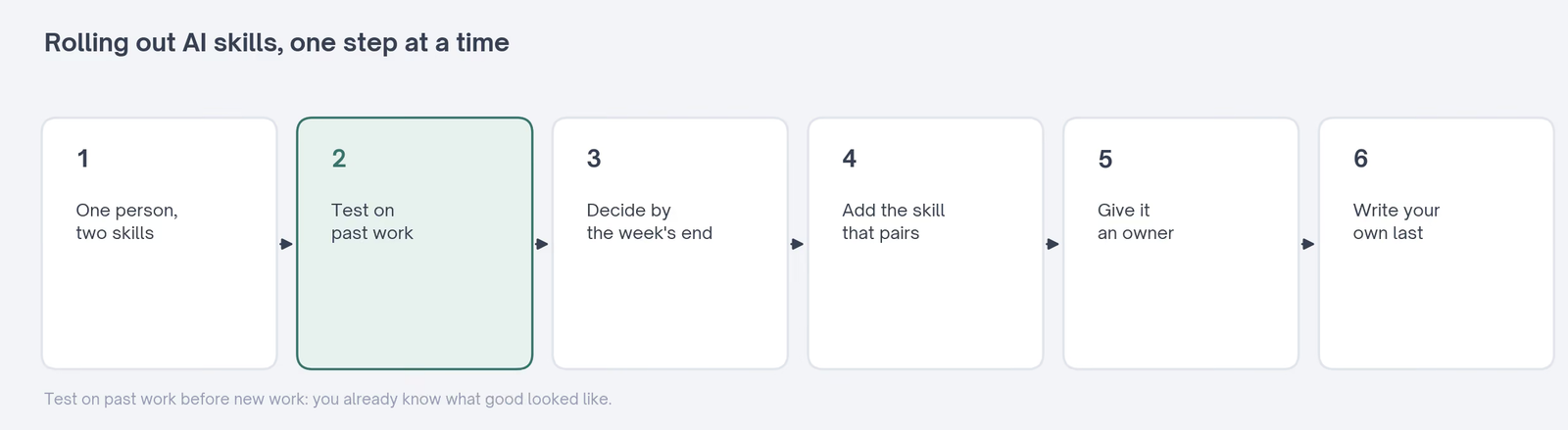
Ten skills is a lot for one team to adopt at once. Two or three that run every week will teach the team more than ten installed and forgotten.
- Start with one person and two skills. Pick the pair for your team from the section above.
- Test them on past work first. Put three pieces you've already published through each skill. You already know what good looked like, so you can judge the output.
- Decide by the end of the week. Keep each skill, change its instructions, or drop it.
- Add the skill that pairs with it. The campaign plan sets goals and metrics. The marketing analytics skill reports against them a month later. Copywriting pairs with fact-checking, since pricing and product copy carries checkable claims.
- Give each skill an owner. Someone needs to notice when it drifts and edit it.
- Write your own skill last. By then you'll know which job your team repeats most.
Chaining skills has a cost. Each handoff is a place where one skill's mistake becomes the next skill's input, so a person should read the output at the point where it leaves the team.
Where These AI Skills Fall Short
A few limits apply to all ten:
- They follow instructions; they don't judge them. A skill built on a weak process repeats that process faithfully.
- Several need connections. The brief, paid search, and analytics skills depend on accounts with Semrush, Google Ads, or Coupler.io.
- Install counts aren't quality scores. A popular skill is a good starting point, and you still need to test it on your work.
- Anything that reaches a customer needs a person. Outreach, ad changes, and published claims should pass an approval step.
Where to Go Next on the Exchange
- The skills directory, with every listed skill and its limits.
- Best Claude marketing skills, a tested shortlist with five skills built from scratch.
- What are Claude skills, a look inside the folder.
- Workflows versus skills, the same job built as a workflow and as a skill.
- The Exchange workflow library, with the TripleDart skills above and dozens more.