


Preview
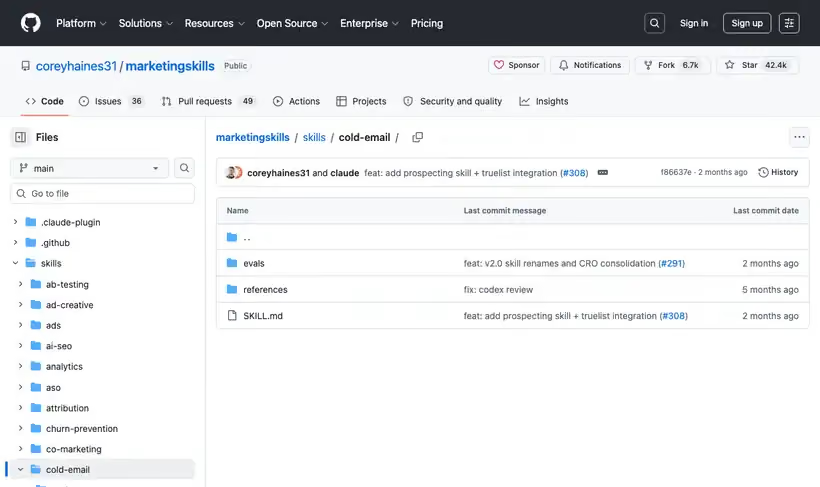
What it is.
You give it the role you are writing to and why them, the outcome you want, your proof and one research signal. It writes the email and the follow-up sequence, and it works from partial answers instead of blocking.
The check worth stealing runs on the sequence you already have: delete the personalized opening and reread. If the email still makes sense, the personalization was decoration. Four personalization levels are documented so effort can match account value.
What you get.
- Subject lines, opening lines, body copy and calls to action for one campaign
- Multi-touch follow-up sequences, where each touch builds on the one before
- A four-level personalization system, with research signals listed per level
- The deletion test for whether your personalization connects to the problem
- A note on which missing input would have improved the draft
How to set it up.
Install with npx skills add coreyhaines31/marketingskills --skill cold-email -a claude-code.
Run product-marketing first, so the skill reads your positioning from .agents/product-marketing.md instead of asking again.
Name the role and the company, and say why them specifically. A segment is not an answer here.
Give it one research signal, whether that is funding, a hiring pattern, a LinkedIn post or a stack change. This is what the opening line is built from.
State your proof as a result or a case study, because the skill allocates a line to it instead of to adjectives.
Apply the deletion test to the draft. Cut the personalized opening and reread. If nothing breaks, the opening is decoration.
Pricing Plans
Free. MIT license.
Checked against the repo in July 2026.
Use cases
Outbound from one signal
You have a funding announcement and a proof point, and that's the whole file. Give it the role you're writing to plus that signal, and the opening line gets built from the signal with a line allocated to your proof.
Autopsy on a silent sequence
The sequence gets no replies and nobody agrees why. Paste it in and run the deletion test: cut the personalized opening and reread, and if the email still makes sense the personalization was decoration.
Follow-ups that build
Your follow-ups restate the first email with a nudge on top. Ask for the sequence in the same session and each touch builds on the one before it.
A standard for the team
Each rep writes outbound their own way. The four personalization levels match research effort to account value, and that rule travels to the whole team with consistent output coming back.
Best for
Diagnosing a sequence that gets no replies
The deletion test and the personalization levels give you a concrete read on why, instead of a general opinion about your copy.
Writing outbound with one strong signal
It is built to work from a single signal plus a clear value claim, which is the realistic input most reps have.
Setting a standard for an SDR team
Peer voice, contractions and a read-aloud check are rules you can hand to five people and get consistent output.