

Key Takeaways
- A good AI agent use case is a job that repeats, needs data the agent can reach through tools, and ends in something you can check.
- The marketing jobs agents handle well today are research-heavy: keyword clustering, content briefs, search term mining, churn risk scoring, and reporting.
- Agents draft and decide the next step. Sending email and moving budget should wait for a person.
- In McKinsey's 2026 survey, revenue gains from AI were most often reported in marketing and sales, yet only 37 percent of respondents saw any impact on profit.
The most useful AI agent use cases for marketing teams are jobs where the agent gathers information from several systems and turns it into a draft. Examples include keyword research, content briefs, paid search audits, churn risk scores, and weekly reports.
What Makes a Job a Good AI Agent Use Case
Most marketing teams already use AI to write. Fewer hand it a job with several steps, where it has to look things up, decide what to do next, and come back with something finished.
That second kind of work is what an agent does. The Exchange has covered how an agent works in detail in What Is an AI Agent?, so this piece stays on which marketing jobs to give one.
The gap between trying agents and getting value from them is wide.
In McKinsey's 2026 State of AI survey, 40 percent of respondents at companies with more than $1 billion in revenue said they were scaling AI agents, up from 27 percent a year earlier. At smaller companies, the figure stayed at 22 percent.
Before handing a marketing job to an agent, I'd ask four questions about it:
- Does it repeat? A job you run every week pays back the setup. A one-off campaign usually doesn't.
- Can the agent reach the data? It needs a tool or a connector for each system it reads, such as your CRM or your ad account.
- Is a wrong step cheap, or caught before it goes out? A bad draft costs a few minutes of review, while a bad email to 5,000 contacts costs far more.
- Can you tell whether it worked? You need a number to compare, such as hours per report or the share of drafts used as written.
A job that clears all four is a good first use case. One that fails the third question can still work, as long as a person approves the risky step.
10 AI Agent Use Cases for Marketing Teams
The jobs below are ones marketing teams run with agents today, grouped from research to reporting. Each links to an Exchange page that walks through the setup, so the table sticks to what goes in and out, and who signs off.
| Job | What you hand the agent | What comes back | Who signs off | Setup on the Exchange |
|---|---|---|---|---|
| Keyword research and clustering | Seed terms and an Ahrefs or Semrush export | Clusters with an intent label for each | An analyst, on the judgment calls | Keyword research with Claude and Ahrefs |
| Content briefs | One keyword, its search results, and your page list | An outline with must-cover topics and sourced facts | The content lead, fact by fact | AI Content Research & Brief Creation Workflow |
| Fact-checking drafts | A finished draft | Each claim with its source, and the ones that fail | The editor | Claude Skill for fact-checking |
| Content for AI search | Target questions and your existing pages | Answer-first briefs and retrofits of old pages | The content lead | 7-Step AEO Workflow |
| AI visibility tracking | Your category and competitors | Which products AI assistants name, and how often | The marketing lead | Slate Index |
| Paid search audits | Read access to the Google Ads account | Search terms to add or exclude, and pacing alerts | The paid media manager, before any change | Claude plus Google Ads MCP |
| Outbound lists and sequences | Your ideal customer profile (ICP) | A scored account list and a drafted sequence | The rep, before anything sends | AI-Powered BDR Engine and ICP Scoring Skill |
| Churn risk scoring | CRM deals, support tickets, and product usage | A health score for each account | Customer success | Churn prediction with HubSpot and Google Sheets |
| Brand and community monitoring | Subreddits and keywords to watch | A short daily digest of mentions to answer | The community manager, who writes the reply | Reddit brand monitoring |
| SEO and AI search reporting | Search Console, GA4, and citation data | The weekly report with the numbers filled in | An analyst, who writes what they mean | Claude for SEO Reporting |
The time savings show up in the gathering.
TripleDart's reporting pipeline cut a report from six hours to 30 minutes. The fact-checking workflow checks a 2,000-word article in under three minutes, against 45 to 60 minutes by hand.
In both, a person keeps the last step. The analyst still writes what the report means, and the editor still makes the call on each flagged claim.
The AI visibility row covers a job most teams don't run yet. Slate's AI citations study followed 90 days of citations across six B2B SaaS brands and six AI platforms, and 76% went to sources beyond the brands and their competitors.
Its AI Overview study ran 1,000 B2B SaaS queries across 40 software categories. Two-thirds of AI Overview citations came from outside Google's organic top 10, so an agent that watches only your own rankings misses most of what assistants quote.
Where Slate Fits
Several of these rows can run in one platform.
Slate tracks how ChatGPT, Gemini, Claude, Perplexity, and Google AI Overviews describe your brand, then runs the content work that follows. Its Cowork agent builds workflows from a prompt and keeps memory across sessions.
Sheets runs a workflow across hundreds of URLs, with human review gates wherever your team adds them, and finished pages publish to Webflow, WordPress, or HubSpot.
Where an Agent Fits, and Where a Workflow Does Better
An agent earns its cost when the steps change from run to run. When they're the same every time, a scripted workflow is cheaper and easier to check, and the Exchange compares those tools in detail in Best AI Workflow Automation Tools.
The second question is what a wrong step costs, since that decides whether the agent finishes the job or hands a draft to a person.
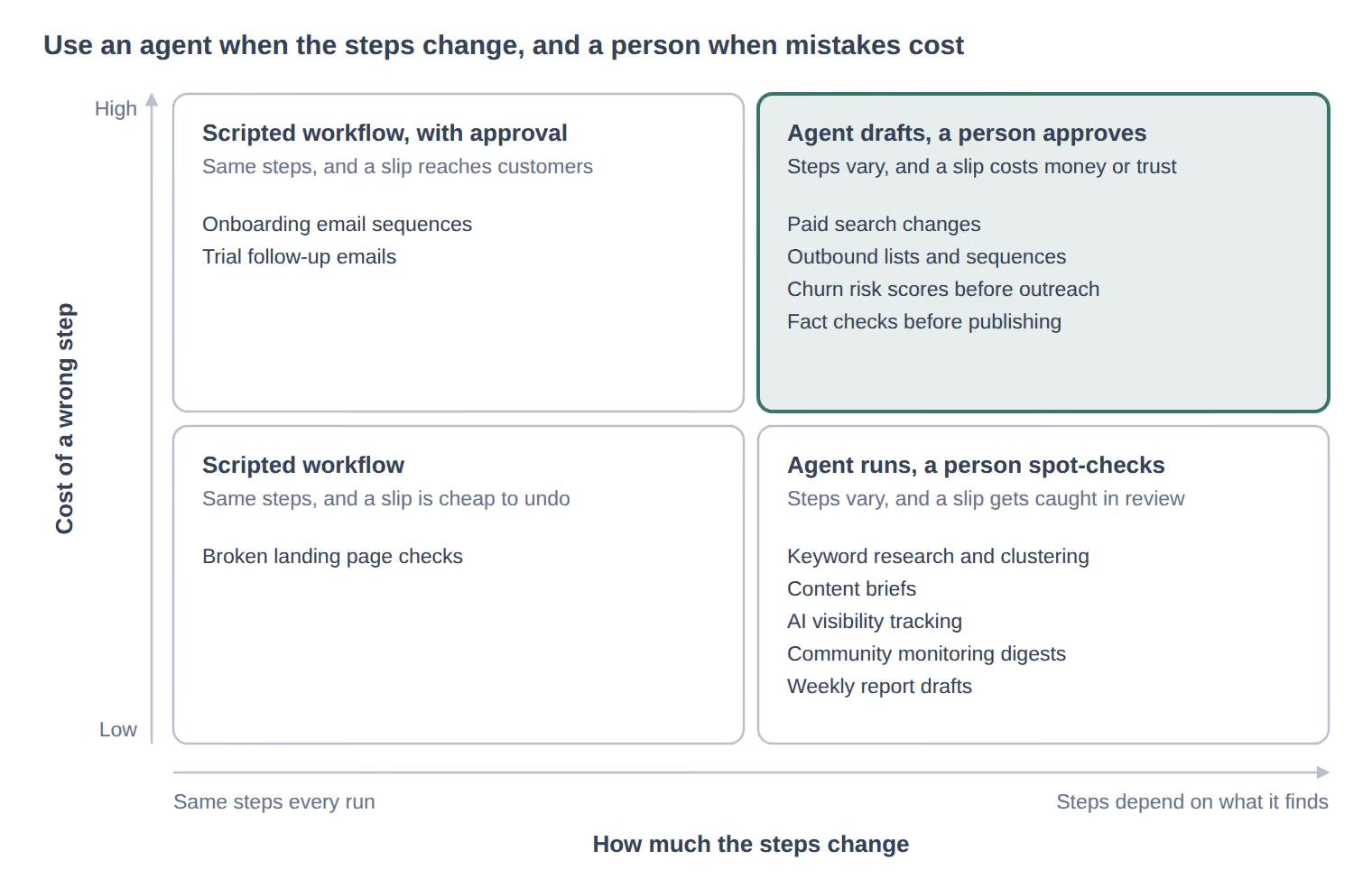
Research and reporting run with a spot check, while anything that sends or spends waits for a person.
Jobs with set steps, such as onboarding sequences and trial follow-ups, run fine as plain automation. So does the Link Checker script.
How to Pick Your First Use Case and Measure It
Start with the job that eats the most hours and does the least damage when it's wrong. Here's the order I'd run it in:
- List the jobs your team repeats each week, with the hours each one takes.
- Run each job through the questions above, and drop any whose data the agent can't reach yet.
- Pick the job with the most hours among those where a mistake gets caught before it goes out.
- Record two weeks of the job done by hand: hours per run, and how often the output gets reworked.
- Run the agent next to the person for the next two weeks, then compare the same numbers.
Redesigning the job matters more than adding the agent to it. In McKinsey's 2026 survey, nearly three-quarters of AI high performers said they had rebuilt workflows around AI, against one-quarter of other respondents.
High performers were also twice as likely to have a defined process for measuring impact. For a marketing agent, four numbers cover it:
| Measure | How to get it |
|---|---|
| Hours per run | The same task timed before and after, by the same person |
| Share used as written | Drafts that go out with light edits, out of all drafts |
| Errors caught at review | Claims, numbers, or targets the reviewer had to correct |
| Cost per run | Model and tool spend for one run, from your provider's usage page |
Cost is the one teams forget. About one in five McKinsey respondents said operating costs, including tokens, had limited their AI use, and about one in ten said so about agents in particular. Check it after the first week, before the number of runs grows.
What Goes Wrong With Marketing AI Agents
Most failures start with what the agent was given. These are the ones that show up in marketing work:
| Failure | What you see | What prevents it |
|---|---|---|
| Stale or messy source data | Churned customers scored as healthy, or duplicate accounts in an outbound list | Limit the agent to the fields you trust, and spot-check a sample each week |
| Confident wrong claims | A draft cites a statistic its source doesn't support | A fact check against the source before publishing, by tool and then by a person |
| An action with no approval step | An email sequence sends, or a budget changes, before anyone looks | Keep sending, publishing, and spending behind a person's approval |
| Two agents working the same accounts | A prospect gets a marketing sequence and a sales email in the same week | One owner per account list, and a shared suppression list |
Inaccuracy is the most common problem in McKinsey's surveys. In the 2025 edition, nearly one-third of all respondents reported consequences stemming from AI inaccuracy.
The 2026 edition found AI high performers much more likely than others to be working to mitigate unauthorized or unintended actions. For a marketing team, that mostly means the approval step in the third row.