


Preview
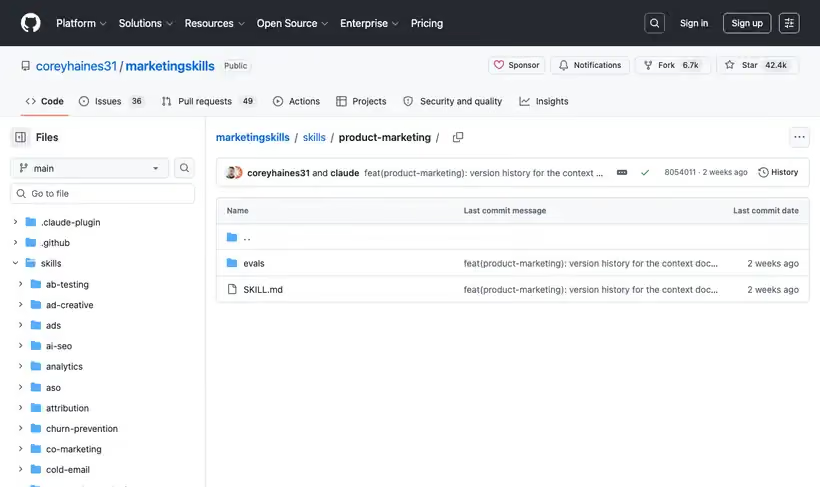
What it is.
It interviews you once, or drafts a first version by reading your repo, and writes the answers to a file at .agents/product-marketing.md. Every other skill in Corey Haines's library reads that file before it asks you anything.
What you get is one less conversation per session. Without it you re-explain your ICP to the copywriting skill, then to cold-email, then to pricing, and the three answers drift apart.
It versions the document and adds a changelog entry on each substantive save, so a positioning change has a date against it.
What you get.
- One context file at .agents/product-marketing.md that the whole library reads
- A first draft assembled from your repo, so you correct instead of compose
- A document version number and a changelog on every substantive save
- Section-by-section updates, so you revise positioning without redoing the rest
- A migration path from older filenames and locations
How to set it up.
Install with npx skills add coreyhaines31/marketingskills --skill product-marketing -a claude-code.
Run it before any other skill in the library. Order matters here more than anywhere else in this directory.
Take the auto-draft option if the repo has a README and any marketing copy in it. Correcting a draft is faster than filling a blank one.
Read every section it drafted. It infers positioning from your own copy, which means it will faithfully reproduce a weak version of it.
Fill the audience and objection sections yourself, because those rarely live in a repo.
Bump the version and let it write a changelog entry on each substantive change, so a positioning change has a date on it.
Pricing Plans
Free. MIT license.
Checked against the repo in July 2026.
Use cases
Setting up the library
You're about to install several skills from the same library. Point this one at your repo first; it drafts the context file from your README and marketing copy, and you correct the audience and objection sections it can't infer.
Dating a positioning change
Positioning moved after a repricing and nobody wrote it down. Update just that section; it bumps the version and adds a changelog entry, so the change carries a date.
Handing a contractor context
A freelancer starts Monday. Run the interview once and hand over the file it writes; their sessions read the same positioning yours do, and the changelog shows how it got there.
Retiring stale context copies
An older context file sits at an old path and something might still read it. Accept the migration it offers; the old file moves into the canonical location and every skill reads one copy.
Best for
Installing more than one skill from this library
Every other skill checks this file first, so it turns a set of separate tools into something that behaves like one.
Keeping brand voice steady across sessions
The file persists, so the copy you get in October matches the copy you got in July.
Onboarding a contractor onto your positioning
One versioned file with a changelog is a better handover than a deck and a call.