


Preview
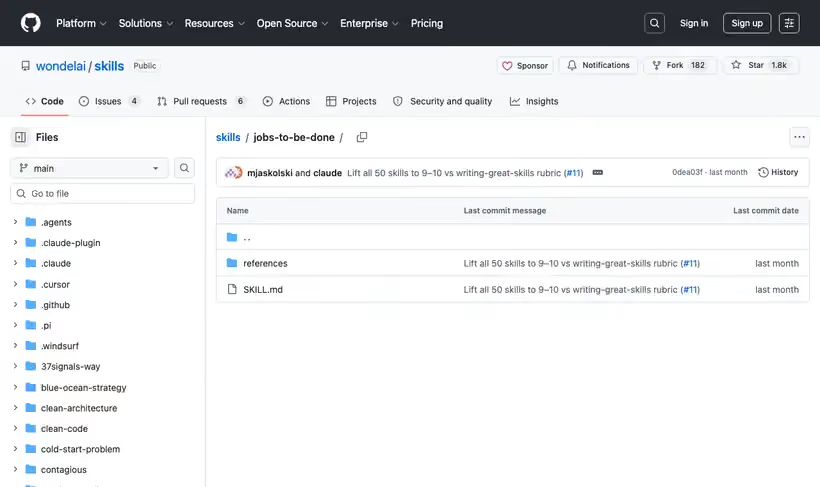
What it is.
You bring interview notes from customers who switched recently, and it codes them into Clayton M. Christensen's jobs framework: a job statement, the four forces around the switch, and a competitor list that includes doing nothing.
Then it scores the work out of 10 and withholds points for the two things this research usually gets wrong, a job statement with your own product name inside it and a competitor list that leaves out non-consumption.
What you get.
- A job statement written as progress, with the product name kept out of it
- All three job dimensions evidenced: functional, emotional and social
- The four forces mapped, so you see what pulls a switch and what blocks it
- A competition list that includes non-consumption, which is where most churn hides
- A score out of 10 naming the diagnostic rows you failed
How to set it up.
Install with npx skills add wondelai/skills/jobs-to-be-done --global, or take the product-strategy plugin.
Bring interview notes from people who switched recently. The switch is the event the framework reads, so a satisfaction survey is the wrong input.
Write the job statement first and then delete every product name from it. If the sentence collapses, the job was a feature description.
Describe the circumstance the customer was in. Company size and job title are the inputs the framework treats as noise.
Evidence all three dimensions. A job with only a functional dimension scores badly, and it is the usual failure.
Add non-consumption to your competitor list. For most B2B products the leading alternative is a spreadsheet and nothing else.
Pricing Plans
Free. MIT license.
Checked against the repo in July 2026.
Use cases
Coding unread transcripts
Interview recordings pile up and nobody reads them. Paste notes from customers who switched recently; back come a job statement, the four-forces map, a competitor list that includes non-consumption, and a score out of ten.
Explaining unexplainable churn
Usage looked healthy and the account left anyway. Feed it the exit interviews; the forces map shows what pulled them toward the switch and what your product stopped answering.
Stress-testing a job statement
You already wrote a statement and suspect it's a feature description in disguise. Hand it over; it fails any statement carrying your product name and withholds points where the emotional and social dimensions have no evidence.
Feeding the positioning canvas
A positioning exercise is scheduled and the alternatives list is blank. Run this on switch interviews first; the competitor list, non-consumption included, becomes the input the canvas asks for.
Best for
Churn you cannot explain
If usage looked healthy and they left anyway, the job they hired you for probably changed. That is the question this framework is built around.
Before a positioning exercise
The job statement feeds the alternatives list in obviously-awesome, so running this first makes that work faster.
Interview notes nobody has read
It gives you a structure to code transcripts against, which turns a folder of calls into a decision.