


Preview
What it is.
You paste in your current offer and it rebuilds it against Alex Hormozi's value equation: raise the dream outcome and the odds of reaching it, cut the time delay and the effort. Every recommendation moves one of those four terms.
You come out with a rewritten offer, a bonus stack, a guarantee that reverses the buyer's risk, and a score out of 10 naming the rows you failed. Time delay is usually the cheapest term to move, so start there.
What you get.
- A rebuilt offer scored against the value equation, term by term
- A bonus stack that raises perceived value without cutting price
- Guarantee structures that reverse the risk the buyer is carrying
- Scarcity and urgency framed so they stay honest
- A score out of 10 with the 7 diagnostic rows you failed
How to set it up.
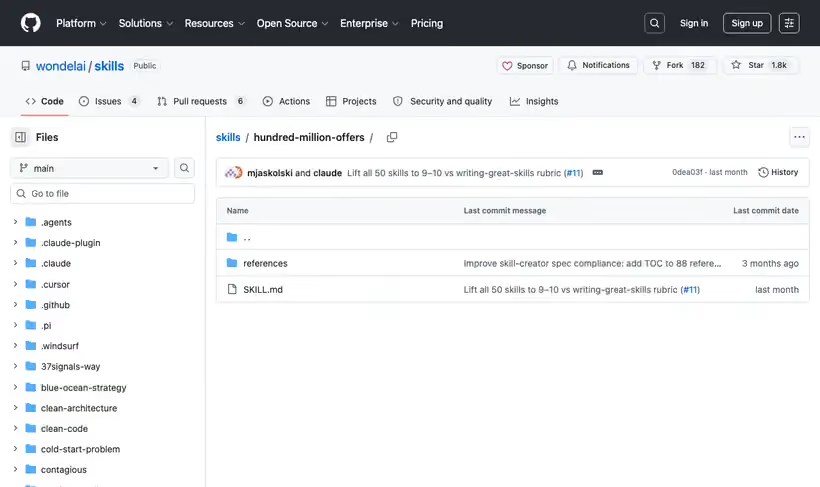
Install with npx skills add wondelai/skills/hundred-million-offers --global, or take the sales-influence plugin.
Write down your current offer as the buyer sees it: price, what they get, how long it takes, what they have to do.
Work the four terms in order. Dream outcome sets the ceiling, so raise that before you touch anything else.
Attack time delay next. Faster results command a premium, and it is usually the cheapest term to move.
Raise perceived likelihood with proof, a guarantee or a track record. The framework treats this as often mattering more than your actual results.
Add bonuses only after the core offer scores well. A stack on a weak offer reads as padding.
Pricing Plans
Free. MIT license.
Checked against the repo in July 2026.
Use cases
Diagnosing a leaky funnel
Every stage converts badly and page tests haven't helped. Paste the offer as the buyer sees it: price, what they get, how long it takes, what they must do. Back comes a rebuilt offer and a score naming the rows that failed.
Building the guarantee
High-ticket buyers stall at the signature. Hand it the current offer; you get guarantee structures that move the risk off the buyer, plus proof angles that raise the perceived odds of the outcome.
Carrying a price increase
The price needs to go up without the offer feeling thinner. Give it the current offer; it raises the dream outcome, cuts the time delay, and stacks bonuses so the increase has something behind it.
Rescoring after one change
You moved a single term and want to know if it cleared. Rerun with the revised offer; the score comes back with whichever diagnostic rows are still failing.
Best for
A funnel that converts badly at every step
If every stage underperforms, the offer is the likely cause and no amount of page testing finds it.
Services, courses and high-ticket B2B
The bonus and guarantee mechanics apply cleanly where the price is negotiated and the deliverable is a promise.
Justifying a price increase
Moving the dream outcome and the time delay gives you something to change besides the number.