


Preview
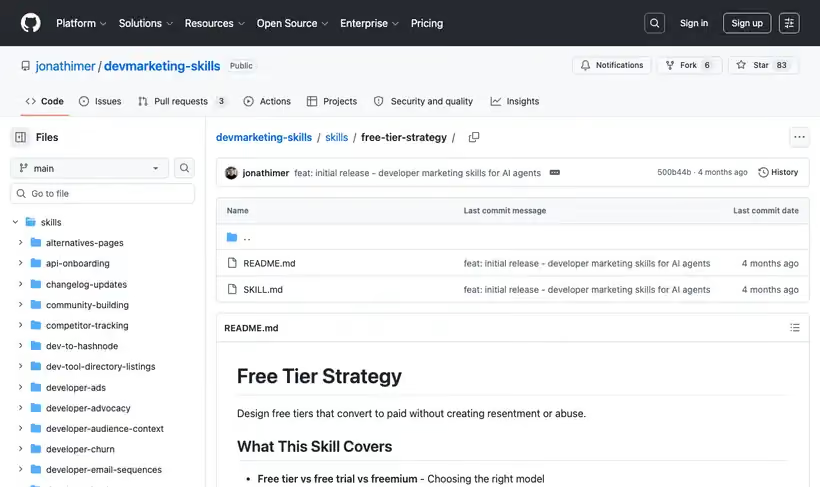
What it is.
You bring your unit economics and it designs the tier: where the usage limits sit, what stays free permanently, and what the upgrade trigger is.
It separates three models and matches each to a sales approach, so a 14-day timer gets pointed at high-touch enterprise sales and a permanently limited tier at self-serve developer adoption. The brief is generous to individuals and scaling into paid as projects grow.
What you get.
- Clear definitions separating free tier, free trial and freemium
- A match between each model and the sales approach it suits
- Usage and feature limit design that scales with a project
- Upgrade trigger design, so the paid moment arrives naturally
- A unit economics check before you set any limit
How to set it up.
Install with npx add-skill jonathimer/devmarketing-skills.
Work out what a free user costs you before designing anything. The skill asks for unit economics first, and every limit follows from that number.
Pick the model deliberately. A 14-day timer suits an enterprise sale and reads badly on a developer tool.
Set limits on usage that grows with a project instead of on features developers need to evaluate you at all.
Check that a hobbyist can build something meaningful inside the free tier, since that is the adoption path.
Design the upgrade trigger as a natural ceiling a growing project hits, not as a wall you place in front of an evaluation.
Pricing Plans
Free. MIT license.
Checked against the repo in July 2026.
Use cases
Replacing a trial timer
Your developer tool runs a two-week trial and signups stall at the wall. It matches each model to a sales approach, pointing timers at high-touch enterprise deals and a permanent limited tier at self-serve adoption, then designs that tier.
Limits from unit economics
Nobody knows what a free user costs. Bring the unit economics and every limit gets derived from that number, with usage caps placed where a growing project hits them naturally.
Free users who never pay
The free tier is full and revenue is flat. The usual diagnosis is feature gating where usage limits belong, and the redesign moves the ceiling so evaluation stays open while growth triggers the upgrade.
Drawing the open source line
The commercial tier keeps cannibalizing the open source project, or the reverse. The model definitions plus the unit-economics check give you a boundary between free and paid you can hold.
Best for
A developer tool with a 14-day trial
The skill's direct read is that this suits enterprise sales and works badly for self-serve developer adoption.
Free users who never convert
Usually feature gating where usage limits belong, which caps evaluation instead of growing with the project.
Open source with a commercial tier
Named as a case, and the boundary between free and paid is the hardest part to place.